glasstec 2026 · Meetings

Book a meeting at the booth

Hall 12, Booth G71 · Messe Düsseldorf · 20–23 October 2026. Half-hour slots with our sales team every day, and with Ing. Martin Molnár, Owner and Managing Director, on Wednesday 21 October.

We will be at the booth throughout the fair – English, German and Chinese speakers from Tuesday to Thursday, English on Friday. Walk-ins are welcome; book a slot to be sure someone has time for you.

Choose a day and timeWrite to us

A tenth of the tin. A sixth of the platinum-group metals.

  • 10×less tin in sensitising and passivation
  • ≈ 6×less platinum-group metal in activation*
  • > 20×less metal in the rinse water
  • in full-scale production useon several silvering lines

* on lines using water-borne paint

The week at a glance

The fair is open daily 09:00–18:00 · Düsseldorf time

Tuesday

20 Oct

Team at the booth
EN · DE · 中文
Sales slots
EN / 中文

Wednesday

21 Oct

Team at the booth
EN · DE · 中文
Sales slots
EN / 中文
Martin Molnár
By reservation

Thursday

22 Oct

Team at the booth
EN · DE · 中文
Sales slots
EN / 中文

Friday

23 Oct

Team at the booth
EN
Sales slots
EN, until 12:00

No appointment is needed to talk to the team – just come by. A booked slot makes sure someone is free for you.

1 · Choose a day

2 · Who would you like to meet?
3 · Meeting language
Choose a half-hour · Tuesday, 20 October 2026

Düsseldorf time (CEST). Occupied slots cannot be booked.

Your details

Choose a time first; the form appears here.

Tin · sensitising and passivation

10×

Tin consumption falls to a tenth

Tin sprayed onto the glass · mg per m² of mirror
conventional chemistry · 94 mg of tin per m² of mirror
EGO 93 · 9.3 mg

Tin is applied to the glass in two steps: sensitising and passivation. A comparable amount of tin remains on the mirror, while about 21 times less goes into the rinse water.

Platinum-group metals · activation

≈ 6×*

Platinum-group metal consumption falls to about a sixth

Platinum-group metals in activation · mg per m² of mirror
conventional chemistry · 7.96 mg of platinum-group metals per m² of mirror*
EGO 93 · 1.33 mg

Besides the platinum-group metals, Superactivator also contains a reducing agent. Most of the metal is therefore deposited on the glass, and about 26 times less goes into the rinse water. The figure applies to lines using water-borne paint (the “for green” range).

* on lines using water-borne paint. On lines using two-coat solvent-borne paint, Superactivator reduces the dose by about 2.4×.

Silvering line

What EGO 93 supplies for the silvering line

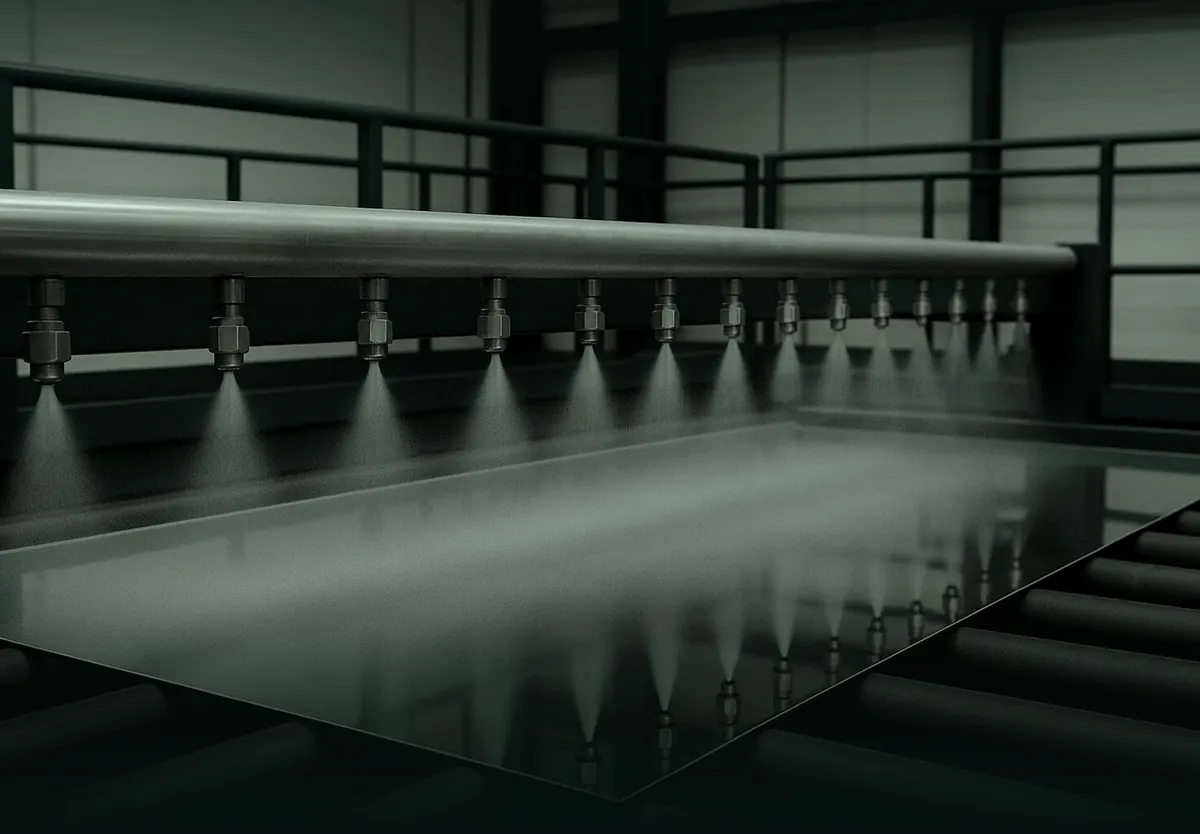
A mirror is made on a silvering line in seven steps. EGO 93 supplies the chemistry for four of them: sensitising, activation, silvering and passivation. The line stays as it is; only the concentrates in the tanks change.

Silvering line · the glass moves from left to right
  1. Cleaningcerium oxide polishing, rinse with demineralised water
  2. Sensitisingtin on the clean glassSupersensitizer
  3. Activationpalladium and ruthenium on the tin layerSuperactivator
  4. Silveringsilver layerMS silvering solutions
  5. Passivationtin on the silver layerSuperpassivation
  6. Silanisationbonding layer for the paint
  7. Paintingprotective paint and curing
  • patented EGO 93 concentrates (steps 2, 3 and 5)
  • MS silvering solutions from EGO 93 (step 4)
  • steps for which EGO 93 does not supply chemistry

Changeover

The line needs no rebuilding

The changeover requires no investment in equipment and no rebuilding of the line. What changes are the concentrates, their dilution as specified in the technical data sheet, and the nozzle maintenance routine; the pumps, nozzles, line speed and sequence of steps stay the same.

EGO 93 for green

What the for green range is

Complete EGO 93 chemistry for lines using single-coat water-borne paint

Sensitising, activation, silvering and passivation from a single manufacturer. The range consists of the same concentrates as our Supersensitizer and Superactivator, together with MS silvering solutions.

On lines using water-borne paint, the platinum-group metal saving is greatest.

≈ 6× less

Platinum-group metals in activation · mg/m²
Conventional chemistry · 7.96 mg/m²
EGO 93 · 1.33 mg/m²

Model mirror plant · 5,000,000 m² of mirrors a year

Lower carbon footprint, less metal in the rinse water and less sludge

The amount of metal remaining on the mirror is comparable with today’s. What changes is how much metal the mirror plant buys, how much of it is washed away with the rinse water and how much sludge results from it.

−83%

Carbon footprint

Almost all of the carbon footprint of the metals purchased for sensitising, activation and passivation is due to the platinum-group metals. A sixth of the platinum-group metal dose therefore reduces this footprint by 83%. For tin, −90%.

≈ 21×

Rinse water

The volume of rinse water does not change; what changes is the amount of metal the water carries away: ≈ 21× less tin and ≈ 26× less platinum-group metal.

≈ 27 t → ≈ 1.3 t

Tin sludge

Tin dissolved in the rinse water is precipitated, and the sludge is dewatered, transported and landfilled. The less tin goes into the water, the less sludge is produced: wet sludge per year.

Illustrative calculation: 28 t CO₂e per kg of primary palladium (IPA 2022); for illustration we have applied the same value to the whole mixture of palladium and ruthenium. Emission factors of metals vary by up to an order of magnitude depending on their origin, so we give ratios: whatever value is assigned to a gram of metal, the carbon footprint of the purchased metal falls by 90% for tin and by 83% for platinum-group metals.
At the booth

What you will see at our booth and take away with you

  1. An indicative calculation for your line: how much less tin, platinum-group metal and sludge there would be after the changeover. All we need is your paint type, annual output and current dosing.
  2. A comparison of tin and platinum-group metal consumption for conventional chemistry and for EGO 93 chemistry, expressed per square metre of mirror.
  3. Documentation on how the changeover works – what changes on the line and what stays the same – and the technical data sheets for our products.
  4. The opportunity to agree a production trial on your line.

On Wednesday 21 October our owner, Martin Molnár, will be at the booth all day.

Come by any time – we will be at the booth throughout the fair (Friday: English only). We will gladly go through the comparison with you, prepare an indicative calculation for your line and hand you the technical data sheets. Or write to us beforehand.

Choose a day and timeWrite to us